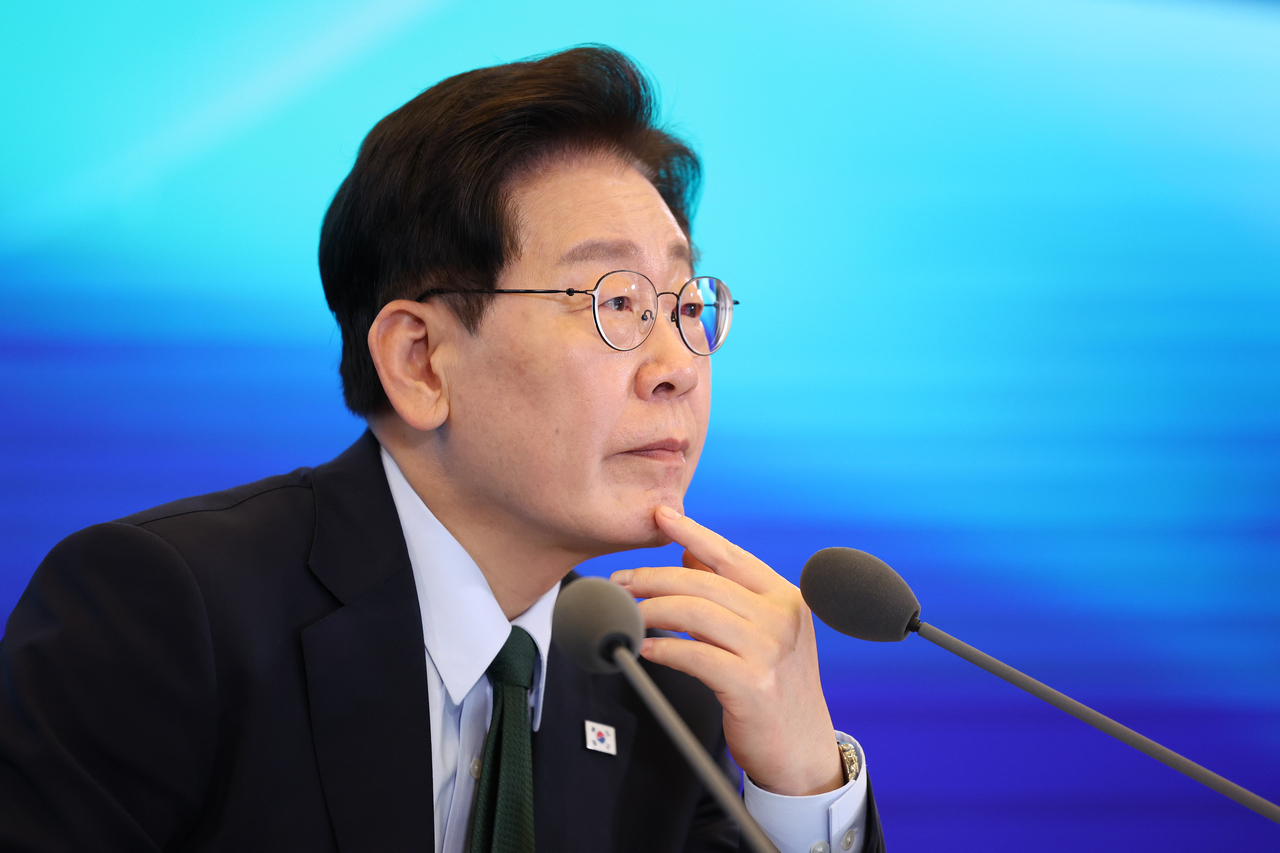
President Lee Jae Myung on Sunday cautioned against granting major steelmakers preferential access to low-cost nuclear power.
Lee stressed that a handful of large corporations should not be allowed to reap the benefits of nuclear power while the public bears the risks and social costs associated with operating nuclear power plants.
"We should be cautious about granting exceptional privileges that would allow just a handful of major corporations in certain industries to monopolize the benefits of nuclear power while the public bears its risks and social costs," Lee wrote in a post on X.
"If we grant such privileges to one steelmaker, won't other companies follow suit? And eventually, won't companies in other industries demand the same treatment?"
Lee made the remarks while sharing a report by the Korea Economic Daily that the Ministry of Climate, Energy and Environment had effectively rejected proposals to introduce nuclear power purchase agreements for energy-intensive industries seeking to reduce carbon emissions.
Under the proposed arrangement, steelmakers would be able to purchase electricity directly from nuclear power generators, potentially securing a more stable and affordable power supply to support their transition to low-carbon production.
According to a document submitted by the ministry to Rep. Park Soo-min of the main opposition People Power Party and made public Friday, the ministry effectively opposed allowing select companies to purchase low-cost nuclear electricity directly.
"Allowing a particular consumer to monopolize low-cost power generation would shift electricity costs onto other consumers and raise concerns about fairness," the ministry said.
The ministry raised concerns that giving certain companies exclusive access to cheaper nuclear electricity could increase power procurement costs for state-run Korea Electric Power Corp., potentially leading to higher electricity rates for households and other manufacturers, according to the report.
The ministry reportedly reached a tentative decision against introducing nuclear-based PPAs for steelmakers during internal discussions last month, partly out of concern that similar demands could emerge from other energy-intensive industries, including semiconductors.
The debate comes as South Korea's steel industry faces mounting pressure to decarbonize production while maintaining its global competitiveness.
Steelmakers are seeking to adopt hydrogen-based steelmaking technologies that replace coal with hydrogen in the ironmaking process, a transition requiring substantial amounts of electricity.
The push has gained urgency as the European Union's Carbon Border Adjustment Mechanism, which places a carbon price on certain carbon-intensive imports, entered its definitive phase in January.
The steel industry views access to stable, affordable, low-carbon electricity as essential to making the transition commercially viable, given the high electricity costs associated with hydrogen production.
Lee's remarks also came just four days after he unveiled the government's Korean Green Transformation, or K-GX, strategy, which places the decarbonization of steel and other carbon-intensive industries at the center of South Korea's green industrial transformation.
Under the initiative, the government has identified hydrogen-based steelmaking as a key industrial priority, with POSCO Holdings participating in a flagship project to build a low-carbon steel production ecosystem.
dagyumji@heraldcorp.com